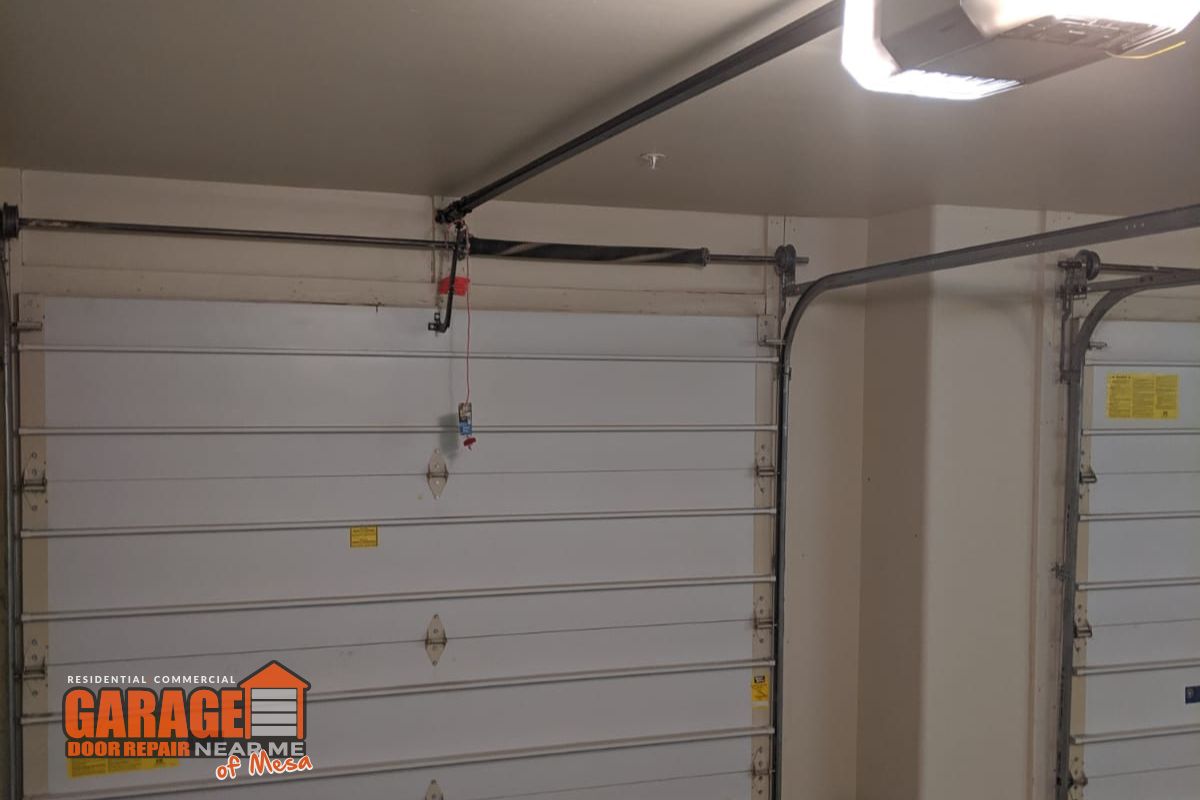
A garage door problem is almost never “random”—it’s usually a load-path failure. When the counterbalance system (torsion or extension springs) loses capacity, the door’s effective weight increases, cable tension rises, and the entire lift system runs outside its designed torque range. That overload can accelerate wear in cable drums, bearing plates, rollers, tracks, and even the opener’s drive components.
This guide explains Spring Replacement vs Full Door Replacement in Mesa, AZ from a mechanical standpoint—what’s actually failing, how pros verify root cause, and why the Arizona heat/dust environment changes the decision.
Most Mesa homeowners notice the first signs the same way: the door suddenly feels heavier, the opener strains or reverses, or the door starts traveling unevenly. In many cases, the underlying issue is spring fatigue—so a targeted garage door spring replacement and repair restores proper counterbalance and reduces stress on drums, bearings, and the operator.
But if the door sections are warped, cracked, delaminated, or no longer seal correctly, balance alone won’t fix structural problems—at that point, a full new garage door installation can be the more durable path. For scheduling, use contact our team and review options on our services page. Coverage and nearby cities are listed under service areas.
Spring Replacement vs Full Door Replacement in Mesa, AZ: the decision rule pros use
A reliable decision starts with one question: Is the door leaf (panels/sections) structurally sound and aligned, or is it compromised? Springs don’t “fix” warped panels, damaged hinges, or misaligned tracks. Meanwhile, replacing an entire door when the only issue is a fatigued spring wastes money and doesn’t address friction sources that can shorten the life of the new system.
A technician-style framework looks like this:
- Define the failure domain: counterbalance, motion path, structure, or controls.
- Verify the load path: shaft, cable drums, bearing plates, and even lift on both sides.
- Validate geometry: track gauge, plumb/level, and racking under load.
- Assess structure: panel bowing, cracked skins, delamination, hinge tear-out, or impact damage.
- Match solution to duty cycle: residential cycles vs high-cycle commercial usage.
Bold takeaway: The right fix restores correct balance and alignment so the opener isn’t forced to “muscle” the door.
What spring replacement actually restores
Spring work is designed to restore counterbalance, which is the system that offsets door weight so the door can move with controlled cable tension and predictable torque.
What spring replacement fixes
A correct spring repair or replacement brings door balance back into a safe operating range, which typically:
- Reduces operator motor torque load
- Stabilizes cable tension and drum tracking
- Prevents opener strain, reversal, and premature drive wear
- Lowers stress on hinges and top section reinforcement
What spring replacement does not fix
It does not correct:
- Warped or cracked panels
- Delamination or section joint deformation
- Seal failure and persistent gaps
- Bent tracks or track gauge misalignment
- Chronic racking (door twists during travel)
Bold takeaway: Springs fix balance and load. They don’t rebuild a failing door structure.
Door replacement: what it solves mechanically
Full door replacement is a structural reset. It addresses the door leaf and its interface with hinges, rollers, and sealing surfaces.
What door replacement fixes
A new door can correct or dramatically reduce:
- Panel structural stress from bowing, cracking, or section joint deformation
- Gaps caused by UV-hardened seals and aged perimeter weatherstripping
- Recurring fit problems that amplify vibration and noise
- Thermal/air intrusion issues that become more noticeable in extreme heat
If the damage is localized, section-level service may be enough. When only one section is compromised, garage door panel replacement and repair can be the middle-ground solution between spring work and full replacement.
Bold takeaway: Replace the door when the structure or fit is compromised—especially if the problem returns after alignment and balance corrections.
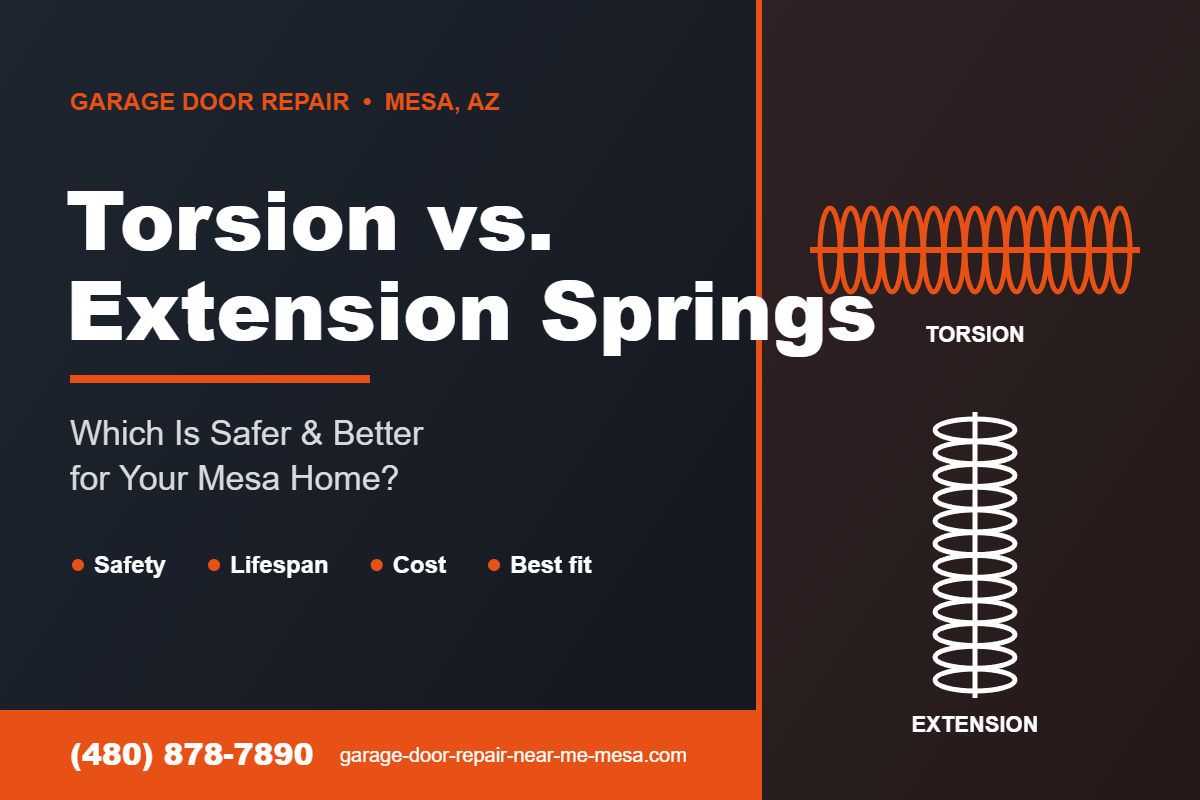
Counterbalance fundamentals: torsion springs vs extension springs
Understanding the spring type helps explain why symptoms show up the way they do.
Torsion springs
Torsion springs mount on a shaft above the door. As the door closes, springs wind and store torque; as it opens, they unwind and rotate the shaft. That rotation turns cable drums, lifting the door through cables while loads transfer through end and center bearing plates.
Why it matters: If a torsion spring fatigues, the door becomes heavier and torque demand spikes. That extra load often shows up as opener strain or a “dead heavy” manual feel.
Extension springs
Extension springs stretch along the horizontal tracks and rely on pulleys and multiple attachment points. More moving points typically means:
- More wear surfaces
- More noise potential
- More dust-driven friction in Mesa conditions
Bold takeaway: Spring type affects symptom patterns, but the core principle is the same—loss of spring capacity increases load everywhere.
Motion path mechanics: drums, bearings, tracks, and rollers
Even when springs are the headline problem, pros still inspect the supporting components because they determine whether repair will hold.
Cable drum systems and even lift
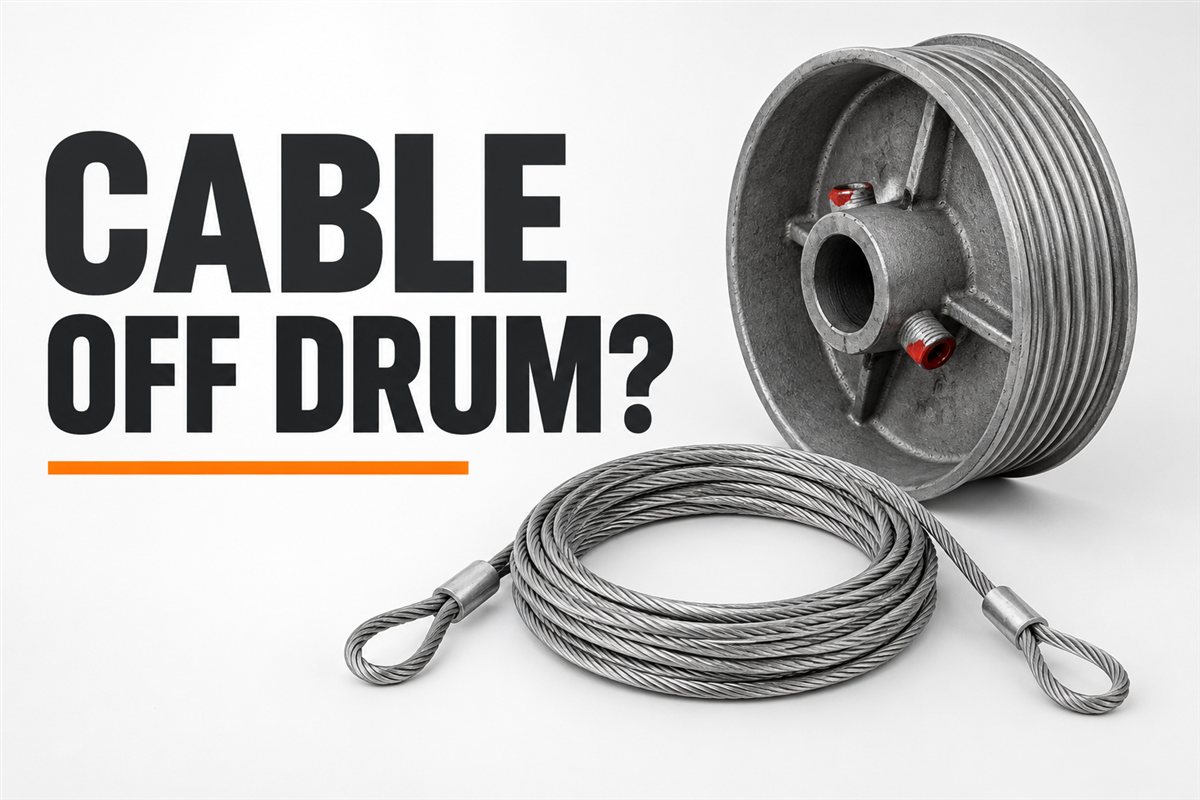
Cable drums must maintain proper cable tracking and consistent wrap on both sides. Uneven wrap increases racking and can cause the door to climb one track harder than the other, accelerating roller and hinge stress.
Bearing plates and shaft alignment
Bearing wear allows shaft wobble. That wobble changes drum geometry under load and can create inconsistent cable tension during travel—leading to jerky motion, noise, and long-term opener strain.
Track gauge misalignment
A track that’s slightly out of gauge can bind rollers and force the door to “fight” its path. In Mesa, heat expansion and settling can loosen mounting points and subtly shift alignment. When binding shows up, garage door track repair and realignment becomes part of the correct repair plan.
Roller wear: nylon vs steel
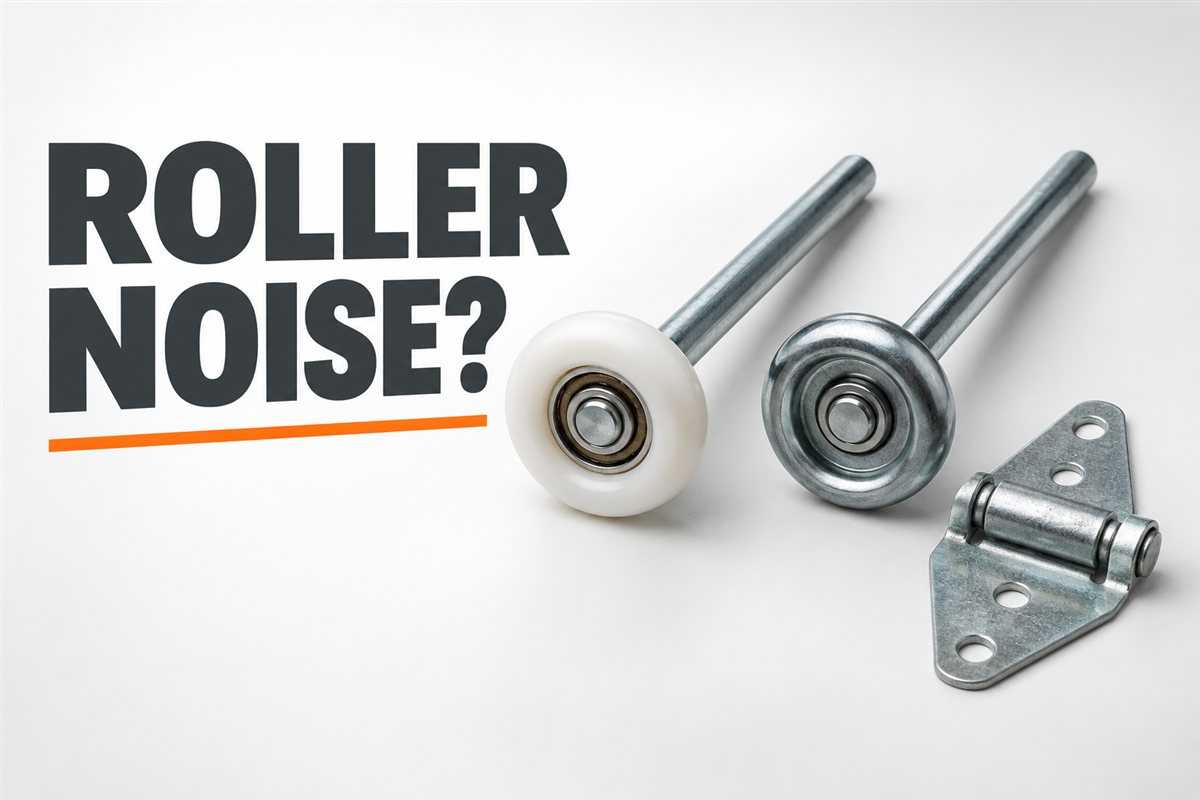
- Nylon rollers run quieter but can degrade faster under heat and dust if low-grade.
- Steel rollers tolerate abrasion but can get noisy and transfer vibration into the track system.
Bold takeaway: Springs restore balance, but tracks/rollers determine smooth, low-torque travel.
Arizona environment factors: heat expansion, dust infiltration, UV seal degradation
Mesa isn’t a neutral operating environment. Several local accelerators impact the repair-vs-replace decision:
- Arizona heat expansion: thermal cycling can shift track spacing and fastener torque over time.
- Dust infiltration: dust increases rolling friction and hinge wear, which raises opener torque demand.
- UV seal degradation: perimeter seals harden and crack, creating gaps and vibration points.
These don’t automatically mean you need a new door—but they do mean diagnostics must confirm the door can run smoothly after repair without recurring drift. A periodic garage door maintenance and tune-up service is often what prevents a “simple spring issue” from turning into a chain of secondary failures.
Bold takeaway: In Arizona, friction control and alignment stability matter as much as spring condition.
Opener behavior: torque load, limits, sensors, and drive type
An opener often fails second, not first. When springs fatigue or tracks bind, the opener compensates by pulling harder, increasing heat and wear.
Operator motor torque load
Higher door resistance forces higher motor torque. That can:
- Trigger force-limit reversals
- Overheat motors
- Stress gears and sprockets
- Shorten the life of belt/chain components
Limit switch calibration concepts
If the travel limits are off, the opener may push the door into the floor or header. That impacts sections and hinges and can mimic “door failure” symptoms even when springs are okay.
Safety sensor alignment
Misaligned sensors can cause intermittent reversals that look like mechanical binding. A professional checks sensor alignment and also confirms that mechanical friction isn’t causing the sensor problem indirectly through vibration.
If operator performance is part of the complaint, handle it through garage door opener repair and installation—but only after verifying door balance and travel geometry first.
Bold takeaway: Fix door mechanics first; then calibrate and validate opener behavior.
Commercial considerations: jackshaft operators, rolling steel tension, loading docks
For Mesa businesses, the threshold for replacement can shift because downtime, safety exposure, and cycle count are bigger drivers.
- Commercial jackshaft operators apply torque directly to the shaft and are sensitive to balance and bearing condition.
- Rolling steel door tension assemblies fatigue differently than sectional door torsion systems, especially under high-cycle commercial usage.
- Loading dock hardware stress adds vibration, impacts, and alignment drift that can warp tracks and panels faster.
If you manage a facility, start with commercial garage door service and support it with commercial door safety inspections and compliance to reduce risk and improve reliability.
Bold takeaway: Commercial decisions prioritize uptime and compliance—replacement can be cheaper than repeated downtime.
Comparison table: Spring replacement vs full door replacement
| Factor | Spring replacement | Full door replacement |
|---|---|---|
| Primary goal | Restore balance/load | Restore structure/seals/fit |
| Best when | Door is straight and solid | Panels/fit/seals are failing |
| Common signs | Heavy door, opener strain | Warp, cracks, gaps, racking |
| Pro focuses on | Drums, bearings, balance | Tracks, framing, sections, sealing |
| Impact on opener | Reduces torque demand | Improves travel + fit stability |
| Cost drivers | Spring rating + system wear | Door type, insulation, labor, fit |
Quick Diagnosis
Symptom → Likely Cause → What a Professional Checks
- Door suddenly heavy → Spring fatigue or break → Spring condition, balance, bearing integrity
- Door lifts unevenly → Drum/cable tracking drift → Cable wrap, drum alignment, shaft/bearing plates
- Door reverses mid-travel → Resistance or settings → Track gauge, roller wear, opener force/limits
- Loud snap/bang → Spring fatigue or joint stress → Springs, hinges, section joints, reinforcement points
- Opener overheating → Excess torque demand → Balance, friction points, drive wear, motor load
- Daylight or gaps at edges → Seal/door warp → Panel straightness, perimeter seals, opening geometry
Cost factors and timelines in Mesa
Cost factors (residential)
- Door weight and construction (single vs double, insulated vs non-insulated)
- Spring type/size/cycle rating and matching to door load
- Condition of drums, bearings, rollers, hinges, and track anchors
- Opener condition and required recalibration (limits/force/sensors)
- Structural issues like panel damage or hinge tear-out
Timeline expectations
- Spring-focused work is often completed in one visit when the system is otherwise within tolerance.
- Full replacement may require ordering, scheduling, and verifying opening geometry and operator pairing.
If the door won’t close securely or the opening is exposed, treat it as urgent and use emergency garage door repair first—then decide on repair vs replacement after a full inspection.
Bold takeaway: In Mesa, the cheapest path is the one that prevents repeat failures in heat and dust.
FAQs
1) Is spring replacement usually cheaper than full door replacement in Mesa, AZ?
Usually, yes—because it targets the counterbalance system rather than replacing sections, seals, and hardware. But if the door is structurally compromised, spring work can turn into repeat labor and added component wear.
2) How long do garage door springs last in Arizona heat?
It depends on cycle rating and daily use. In Mesa, heat cycling and dust-driven friction can increase system load, so alignment and periodic maintenance strongly influence spring lifespan.
3) When is a spring issue considered an emergency?
If the door can’t open safely, can’t close securely, or the opener is straining and reversing under load. High-tension spring systems and heavy doors are safety-critical equipment and should be handled by trained professionals.
4) Can I replace one damaged panel instead of the whole door?
Often, yes—when the damage is isolated and the remaining sections are still true and aligned. Panel repair or replacement is a practical middle option when the rest of the system remains structurally sound.
5) Do commercial doors in Mesa require compliance checks?
Many commercial sites require documented inspections, especially for high-cycle or safety-sensitive openings. Professional safety inspections help reduce liability and catch early wear in tracks, hardware, and operator systems.
6) How fast can a professional complete spring replacement?
In many cases, a trained tech can complete the work in a single appointment if the supporting hardware is in acceptable condition. If there’s track drift, bearing wear, or cable tracking issues, the timeline can extend to ensure safe operation.
7) What should I ask about warranties?
Ask what parts and labor are covered, whether coverage depends on correct balance/alignment, and whether maintenance affects warranty terms. Also ask how operator calibration and hardware condition impact long-term reliability.
8) What’s the biggest safety risk with springs and heavy doors?
Stored energy and mass. Springs can release force suddenly, and heavy doors can shift or fall if components fail—especially in commercial systems. Professional handling is the safest route.
Closing: the right fix for Mesa and nearby cities
In Spring Replacement vs Full Door Replacement in Mesa, AZ, the root decision comes down to this: spring fatigue overloads the system, increasing cable tension, loading drums and bearing plates, and forcing higher opener torque. If the door structure is still solid and aligned, the correct repair path is restoring counterbalance with a professional spring solution and verifying track/roller friction and opener calibration.
If panels are warped, cracked, delaminated, or the door no longer seals and holds alignment—even after corrections—the proper path shifts toward panel-level repair or full door replacement for long-term stability in Mesa’s heat, dust, and UV exposure.
We serve Mesa and surrounding areas including Mesa, Phoenix, Gilbert, Chandler, Tempe, and Scottsdale. Learn more about our approach on About Us or return to the home page.
For a professional diagnosis and a clear recommendation—spring replacement, opener service, panel repair, or a full replacement. Safety reminder: high-tension spring systems and heavy commercial doors can be dangerous if mishandled, so always use trained professionals.