



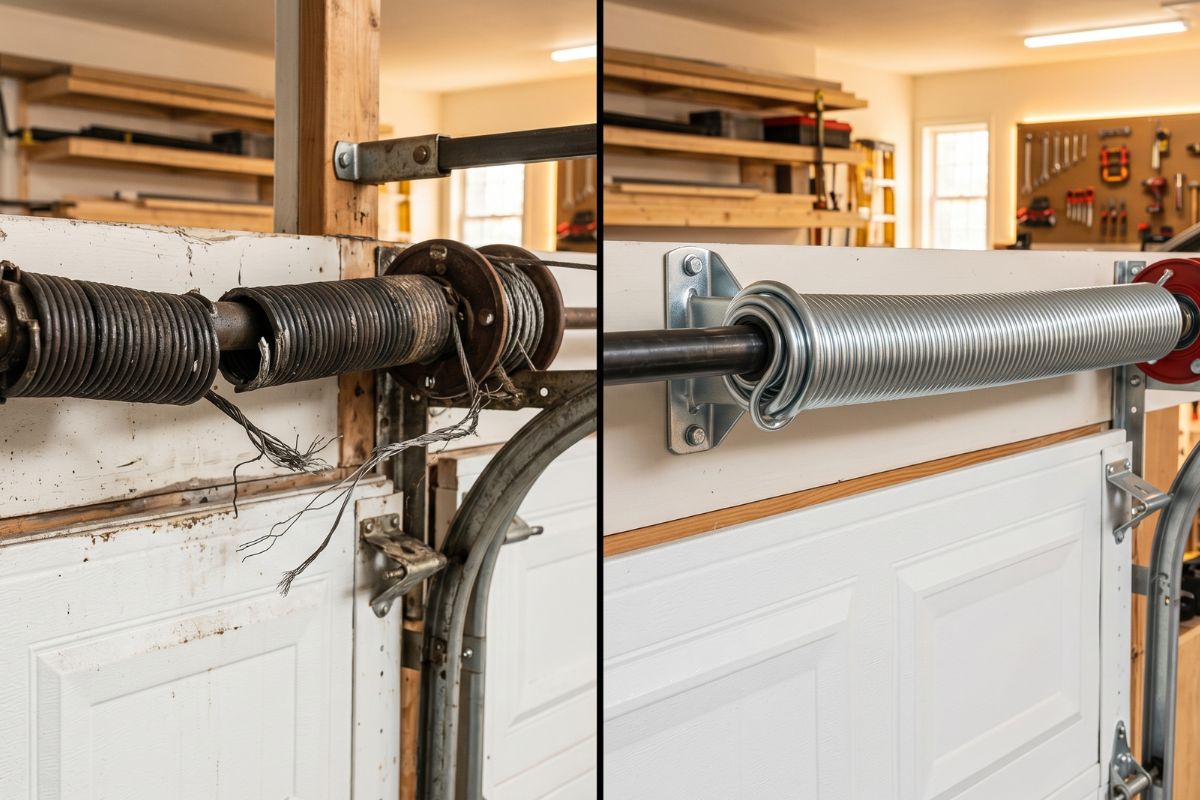
Garage door spring replacement is one of the most critical repairs any Mesa homeowner can schedule — and knowing the signs before a complete failure saves you time, money, and a potentially dangerous situation. At Garage Door Repair Near Me of Mesa, our certified technicians respond to spring failures every day across the East Valley. If your door is struggling to open, making unusual noises, or sitting unevenly in the frame, a failing spring is very likely the cause. Here we walk you through every warning sign so you know exactly when to call us.
Why Garage Door Springs Are the Heart of the System
Every residential garage door repair call we answer starts with a basic question: is the spring system still functional? Springs do the heavy lifting — literally. A standard two-car garage door weighs between 150 and 400 pounds, and the springs offset nearly all of that weight so your opener motor only has to do a fraction of the work. When a spring loses tension or snaps, the entire mechanical balance of the door collapses.
We have been serving Mesa residents and surrounding East Valley communities for years, and our team has replaced thousands of torsion and extension spring assemblies across every neighborhood — from Dobson Ranch to Red Mountain. Our technicians complete manufacturer-authorized training annually, stay current on DASMA safety standards, and carry the tools and replacement parts in every service van to handle same-day jobs without a return trip.
There are two primary spring types you will encounter on any residential door in Mesa:
- Torsion springs — mounted on a shaft above the door opening; the industry standard for modern residential doors due to longer cycle life and balanced operation.
- Extension springs — mounted along the horizontal tracks on each side; common on older systems and lighter single-car doors.
Both types operate under extreme mechanical tension. This is why garage door spring repair is never a do-it-yourself task — improper handling can cause catastrophic injuries. When you see any of the signs below, contact our team at our Mesa garage door location on Google Maps and let us assess the situation safely.
| Warning Sign | Spring Type Affected | DIY Safe? | Urgency Level |
|---|---|---|---|
| Door won’t open at all | Torsion / Extension | No | 🔴 Immediate |
| Visible gap in torsion spring coil | Torsion | No | 🔴 Immediate |
| Door closes too fast or slams | Extension | No | 🟠 Same Day |
| Loud bang from garage | Torsion / Extension | No | 🔴 Immediate |
| Door is crooked or uneven | Extension (one side) | No | 🟠 Same Day |
| Opener strains but door barely moves | Torsion / Extension | No | 🟠 Same Day |
| Spring looks stretched or deformed | Extension | No | 🟡 Schedule Soon |
| Door only opens a few inches | Torsion / Extension | No | 🟠 Same Day |
| Cables hanging loose or off drums | Torsion | No | 🔴 Immediate |
| Spring showing rust or corrosion | Torsion / Extension | No | 🟡 Schedule Soon |
The Most Telling Signs You Need Garage Door Spring Replacement
1. Your Door Won’t Open at All
This is the most definitive sign. If you press the wall button or remote and the opener motor runs but the door does not move — or barely lifts an inch before the motor stops — a broken spring is almost certainly the culprit. A torsion spring failure leaves the full dead weight of the door on the opener, which triggers the motor’s overload protection and shuts it down immediately.
Do not force the door open manually in this situation. The cable tension may also be compromised, and forcing the door can cause track misalignment, cable snapping, or the door falling unexpectedly. Contact our emergency garage door repair team and we will handle it safely.
2. You Heard a Loud Bang Coming From the Garage
Many of our Mesa customers describe this exact scenario: they were inside the house, heard what sounded like a gunshot or a car backfiring from the garage, and found nothing visibly wrong — until they tried to use the door. That sound is the unmistakable signature of a torsion spring snapping under load. The coil releases all stored tension at once, producing a sharp, concussive sound.
This is one of the clearest indicators that immediate spring replacement service is needed. Do not attempt to operate the door after hearing this sound. Call our team and we will dispatch a technician to your Mesa address the same day.
3. You Can See a Gap in the Torsion Spring Coil
If you look above the closed door and notice a visible separation — a gap of one to three inches in the spring coil — the spring has broken. A healthy torsion spring forms a continuous, tightly wound helix. A break creates an obvious split that is visible even from a distance. This is a 100% confirmation that garage door spring replacement is required before the door is safe to operate again.
4. The Door Is Crooked or Opens Unevenly
On systems with two extension springs — one on each side — a failure on one side creates an immediate imbalance. The door rises on the working side while the failed side stays down, causing the door to travel diagonally in the tracks. This is hard to miss. It also places extreme stress on the cable drums, rollers, and tracks on the functioning side, compounding the damage if the door continues to be used.
If your door is crooked during operation, stop using it and schedule a track and spring inspection before the problem escalates to a full track replacement.
5. The Door Closes Too Fast or Slams Shut
A properly balanced garage door closes at a controlled, smooth pace. When springs lose tension — even partially, before a full break — the counterbalance weakens and gravity takes over. The door descends faster than it should, sometimes slamming hard enough to shake the entire frame and send objects off nearby shelves. This is a serious safety hazard, particularly for children and pets who may be near the door during operation.
Our garage door tune-up and balance test can identify spring tension loss before it reaches the slamming stage. We recommend scheduling an inspection annually — especially given Mesa’s temperature extremes, which accelerate spring metal fatigue.
6. The Opener Strains but the Door Barely Moves
Modern garage door openers are engineered to handle a properly counterbalanced door, not the full weight of an unsupported slab. When springs lose tension, the opener motor has to work overtime — you may hear it struggling, grinding, or running longer than usual before giving up. Over time, this stress burns out the motor and strips the drive gear, turning a spring replacement job into a much more expensive opener replacement.
If your garage door opener is laboring noticeably, the spring system should be the first thing we inspect. Catching it early keeps the repair contained to the springs alone.
7. The Door Only Opens a Few Inches, Then Stops
Some openers have a built-in force sensitivity setting that detects unusual resistance and stops the door to prevent motor damage. When springs are failing, the opener senses the excess load, travels a few inches, and then reverses or stops entirely. This safety feature is actually doing its job — but the root cause still needs to be addressed through a proper spring replacement.
8. Visible Rust, Corrosion, or a Stretched Extension Spring
Springs that have lost their shape — extension springs that appear stretched, gapped, or deformed without fully breaking — are functioning at reduced capacity and will fail soon. Similarly, surface rust on torsion spring coils creates friction during operation, wears the coil material unevenly, and dramatically shortens remaining cycle life. In Mesa’s dry but occasionally humid monsoon season, condensation inside the garage can accelerate this process.
Our technicians inspect spring condition as part of every garage door maintenance visit. Applying a lithium-based lubricant to torsion spring coils twice yearly can slow rust development, but visibly corroded springs should be replaced — not just lubricated.
9. Cables Are Hanging Loose or Have Jumped Off the Drum
When a torsion spring breaks, the cables that run from the bottom brackets to the cable drums instantly go slack. You may notice them hanging in loose loops on either side of the door, or coiled on the garage floor. Loose cables are both a symptom of spring failure and an independent hazard — a snapping cable under load carries enough force to cause injury. This always warrants an immediate call for cable and spring repair.
Torsion vs. Extension Spring Replacement: What to Expect
When our technician arrives at your Mesa home, the first step is a full system assessment. We identify the spring type, measure the wire gauge and coil diameter, confirm the door weight class, and check cables, drums, and bearings for wear while we have the system open. We do not replace springs in isolation — we evaluate the entire counterbalance system so the new springs perform at their rated cycle life.
For torsion spring replacement, we wind the new spring to the correct tension using calibrated winding bars — this is where most DIY injuries occur, and why professional service is non-negotiable. For extension spring systems, we also inspect and replace the safety cables that run through each spring, which are required by code to contain the spring in the event of a future break.
We stock standard-cycle (10,000-cycle) and high-cycle (20,000–30,000-cycle) springs in our service vans. High-cycle upgrades are especially popular with our Mesa customers who work from home or have multi-vehicle households with above-average daily door usage. We will walk you through both options and let you decide — no pressure.
Why Mesa’s Climate Accelerates Spring Wear
Mesa’s desert climate creates conditions that are particularly demanding on garage door hardware. Summer temperatures regularly exceed 110°F, causing metal to expand and contract repeatedly across daily temperature cycles. Over thousands of cycles, this thermal stress compounds mechanical fatigue in the spring coil. Monsoon season introduces sudden humidity spikes that promote surface oxidation on unlubricated springs.
We factor these local conditions into every recommendation we make. When a customer on the east side of Mesa asks about spring longevity, our answer is different from what a technician in a northern climate might give. Our experience in this specific market is part of what makes Garage Door Repair Near Me of Mesa the right call — we know what materials hold up here, and we stock accordingly.
Preventive maintenance remains the most effective way to extend spring life in our climate. An annual tune-up service that includes spring lubrication, balance testing, and hardware inspection can add years of reliable operation before replacement becomes necessary.
The Safety Case for Professional Spring Replacement
We want to be direct about this: garage door torsion springs store enough energy to break bones, cause severe lacerations, or worse. The Consumer Product Safety Commission tracks hundreds of garage door-related injuries every year, and a significant portion involve spring systems. Our technicians train specifically on spring handling procedures, use appropriate tools — not makeshift substitutes — and follow DASMA safety guidelines on every job.
Beyond personal safety, professional replacement protects the longevity of the entire door system. Incorrectly wound torsion springs place uneven stress on the shaft, cable drums, and opener, shortening the life of components that were otherwise in good condition. Getting the tension right the first time is a skill that comes from hands-on experience — not from a YouTube tutorial.
We also carry full liability insurance and offer warranties on both parts and labor, so you are protected after the job is done. Check our reviews from Mesa homeowners on our Google Business Profile — our reputation in this community is something we take seriously and work hard to maintain on every call.
What Happens During a Spring Replacement Service Call
Here is exactly what to expect when you book a garage door spring replacement with our team:
- Arrival and assessment — The technician inspects the full system: spring condition, cable integrity, drum wear, track alignment, and opener force settings.
- Upfront quote — You receive a clear, itemized price before any work begins. No surprises.
- Spring removal — Broken or worn springs are removed safely using proper winding tools.
- New spring installation — The replacement spring is wound to the precise tension for your door’s weight class.
- Balance test — We disconnect the opener and manually lift the door to the midpoint. A balanced door stays in place; an unbalanced door will drift. We do not leave until the door passes.
- Safety system check — Auto-reverse and photo-eye sensors are tested to confirm they meet current safety standards.
- Final run-through — We cycle the door several times with the opener connected and confirm smooth, quiet operation before we pack up.
The entire process typically takes 45 to 90 minutes. Most Mesa residents are back to a fully functional residential garage door the same day they call us.
Frequently Asked Questions — Garage Door Spring Replacement in Mesa
Your Garage Door Spring Replacement Team in Mesa Is Ready
If you have recognized any of these warning signs in your own garage — a door that won’t move, a spring with a visible gap, cables hanging loose, or an opener that strains and stops — do not wait for the situation to worsen. A broken spring immobilizes your garage completely, and addressing early warning signs costs significantly less than an emergency call after a full failure.
At Garage Door Repair Near Me of Mesa, our technicians bring years of verified field experience, manufacturer-level parts, and a commitment to transparent, honest service on every job. We serve Mesa and the surrounding East Valley — including Gilbert, Chandler, Tempe, and Scottsdale — with the same level of professionalism we have built our reputation on.
If you want to go deeper on related issues, our article on garage door cable repair covers how broken springs affect the cable system and what signs to look for there as well.
Ready to schedule? Visit our Garage Door Repair Near Me of Mesa listing on Google Maps to confirm our location, read verified customer reviews, and get in touch directly. You can also reach us through our contact page — we respond to every inquiry and will have a technician at your door as soon as you need us.
Do not let a failing spring become a full garage lockout. Contact Garage Door Repair Near Me of Mesa today and get your door back to safe, reliable operation.