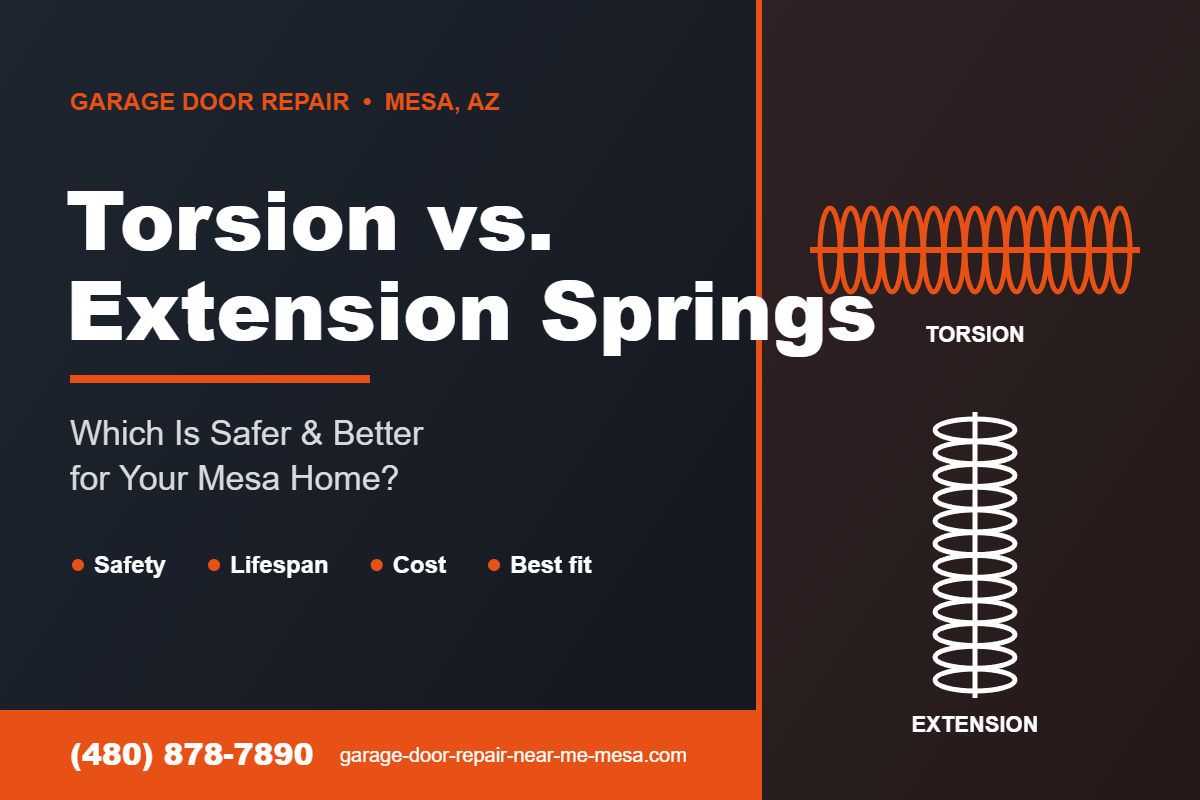
Torsion vs extension springs comes down to a single question: how does your garage door safely counterbalance 150 to 400 pounds of weight every time it moves? Torsion springs mount on a steel shaft above the door and twist to store energy, while extension springs stretch along the horizontal tracks on either side. For most Mesa homes, torsion springs are the safer, longer-lasting, and smoother choice — but extension springs still have a place on lighter doors and low-clearance garages. Below, we break down exactly how each system works, where each one wins, and how to decide with confidence. We install and repair both across Mesa every week.
How Torsion and Extension Springs Actually Work
Before comparing torsion vs extension springs, it helps to understand that both systems exist to do one job: offset the weight of the door so the opener — and your hands, during a manual lift — only move a few pounds instead of a few hundred. The difference is in the physics they use to store that counterbalancing energy, and that difference shapes everything from safety to service life. We see the practical consequences of that difference on nearly every spring repair call we run.
What a Torsion Spring Does
A torsion spring sits horizontally on a metal shaft mounted directly above the door opening. As the door closes, cables wound around drums on each end of the shaft cause the spring to wind up and store energy through torque — the twisting force that gives the system its name. When you open the door, that stored energy releases in a slow, controlled unwind, lifting the door smoothly along its tracks. Because the spring is fixed to a central shaft and anchored at the middle, its force stays contained even at full tension. Most residential doors use one or two torsion springs sized precisely to the door’s weight, and correct sizing is something our Mesa spring technicians calculate before any installation.
What an Extension Spring Does
An extension spring works by stretching rather than twisting. Two springs run parallel to the horizontal tracks, one on each side of the door, and they extend to full tension when the door is closed. As the door opens, the springs contract and pull the door upward through a system of pulleys and cables. This design is mechanically simpler and has been used on lighter sectional doors for decades. It also requires less headroom above the door, which is why older Mesa garages and homes with low ceilings often came equipped with extension springs from the start. The trade-off is that an extension system has more moving parts exposed — pulleys, cables, and the springs themselves — each of which becomes a potential wear point our cable repair team inspects during service.
| Feature | Torsion Springs | Extension Springs |
|---|---|---|
| Location | Horizontal shaft mounted above the door opening | Along the horizontal tracks on each side of the door |
| How It Stores Energy | Twists (torque) as cables wind the shaft | Stretches to full tension when the door closes |
| Failure Mode | Contained — broken halves stay on the shaft | Can whip across the garage — needs safety cables |
| Typical Cycle Life | ~10,000–15,000 (high-cycle up to 20,000+) | ~10,000 cycles |
| Movement & Noise | Smooth, balanced, quieter travel | More bounce and noise; prone to uneven lift |
| Headroom Needed | Requires ~12 in. above the door | Works with limited headroom / low ceilings |
| Best For | Double-car, heavy insulated, and high-use doors | Lighter single-car doors, low-clearance garages |
| Upfront Cost | Higher — better long-term value | Lower — more frequent replacement |
Torsion vs. Extension Springs on Safety
Safety is where the comparison stops being academic. Both spring types store enormous energy, and both demand professional handling — but they fail in very different ways, and that difference matters for your family. In our years serving Mesa homeowners, the failure mode of a spring is the single factor we weigh most heavily when recommending a system, and it is a recurring theme in the emergency calls we respond to.
Why Torsion Springs Fail More Safely
When a torsion spring reaches the end of its life, it typically breaks with a loud bang — but the broken halves stay on the shaft they are mounted to. The energy dissipates in place rather than launching outward. The door will suddenly feel far too heavy for the opener, and it may refuse to lift or slam shut, but flying metal is rarely part of the picture. That contained failure is a core reason we favor torsion systems for families, and it is why our repair technicians can diagnose a broken torsion spring quickly and safely.
The Extension Spring Hazard — and the Safety Cable Fix
An extension spring under full tension stores energy along its entire stretched length. When one snaps, the spring and its hardware can whip across the garage with real force, posing a genuine risk to anyone or anything nearby. The essential safeguard is a safety cable — a steel cable threaded through the center of each extension spring and anchored at both ends. If the spring breaks, the safety cable captures the pieces and prevents them from becoming a projectile. Alarmingly, many older Mesa doors we inspect are missing these cables entirely. If your garage runs extension springs, confirming that safety cables are present and intact is one of the most important checks our maintenance team performs — and one we will never skip.
Both torsion and extension springs hold hundreds of pounds of force at all times. A torsion spring can store over 100 ft-lbs of energy, and an extension spring can release violently across a garage when it fails. Spring replacement, winding, and safety-cable installation require specialized winding bars, precise torque calculations, and professional training. This is never a safe DIY project — the risk of serious injury is real. Always call a licensed Mesa garage door technician.
Performance, Lifespan, and Cost Compared
Safety may settle the argument for many homeowners, but performance and long-term value carry real weight too. Here is how torsion vs extension springs measure up once the door is installed and running day after day through Mesa’s demanding climate.
Cycle Life and Durability
Spring life is measured in cycles, where one cycle equals a single open-and-close. A standard extension spring is typically rated for around 10,000 cycles, while a standard torsion spring is generally rated for 10,000 to 15,000 cycles — and high-cycle torsion springs can reach 20,000 or more. For a household that uses the door four to six times a day, that difference can mean several extra years of reliable service. Because torsion springs distribute force more evenly and endure less flexing stress than a spring that stretches its full length on every cycle, they simply last longer. When homeowners ask us how to extend spring life on either system, the answer is always the same: consistent annual maintenance that keeps tension correct and hardware lubricated.
Balance, Noise, and Smooth Travel
Torsion springs deliver noticeably smoother, more controlled movement. Because the counterbalance force is centralized on the shaft, the door travels evenly and stays properly aligned in its tracks — which also reduces strain on the opener and extends the life of your garage door opener. Extension springs, pulling from both sides, are more prone to uneven lift, bounce, and the jerky motion that develops as one spring wears faster than its partner. That imbalance is also a leading cause of the grinding and squealing that sends homeowners searching for garage door repair in the first place. If your door shudders or hangs crooked, worn springs are a prime suspect our team checks immediately.
Upfront Cost vs. Long-Term Value
Extension springs generally cost less to purchase and install, which is part of why they remain common on entry-level and older doors. Torsion springs carry a higher upfront price because of the heavier-duty hardware and the precision required to install them correctly. Over the full lifespan of the door, though, torsion systems frequently prove the better investment — they last longer, protect the opener, and demand fewer repairs along the way. When we quote a spring replacement, we walk homeowners through both the short-term and long-term numbers so the decision is genuinely informed, whether the job is a simple swap or a full door installation.
Which Spring System Is Right for Your Mesa Home?
There is no universal winner — the right answer depends on your door’s weight, your garage’s clearance, and how heavily you use the door. That said, our experience across thousands of Mesa homes points clearly in one direction for most situations, and we are happy to assess your specific setup during any service visit in Mesa.
When Extension Springs Still Make Sense
Extension springs remain a reasonable option for lighter, single-car doors and for garages with limited headroom where a torsion shaft simply will not fit. If your home already runs a well-maintained extension system with intact safety cables and you are on a tighter budget, replacing like-for-like can be a sound, cost-effective choice. The key conditions are proper safety cables, matched spring pairs, and regular inspection — all of which our maintenance program keeps on track.
Why We Recommend Torsion for Most Mesa Doors
For double-car doors, heavier insulated doors, and any household that uses the garage as a primary entrance, we recommend torsion springs almost every time. The safer failure mode, longer cycle life, smoother travel, and reduced wear on the opener add up to a system that protects both your family and your investment. Many homeowners upgrading from extension to torsion during a new door installation tell us the difference in quietness and smoothness is immediately obvious. The same logic applies to commercial doors, where reliability and high cycle counts are non-negotiable.
Mesa’s Climate and Spring Wear
Mesa’s intense summer heat and wide daily temperature swings put unique stress on garage door hardware. Thermal expansion and contraction accelerate metal fatigue, and dry desert conditions strip lubricant from springs and moving parts faster than in milder climates. That environment favors the durability of torsion springs, and it makes routine care essential for either system. We build these local realities into every recommendation, and our emergency repair team stays ready for the sudden failures that Mesa summers tend to trigger. A quick seasonal check from our Mesa repair specialists often prevents a breakdown before it happens.
Frequently Asked Questions: Torsion vs. Extension Springs in Mesa, AZ
+ Are torsion springs really safer than extension springs?
+ How long do garage door springs last?
+ Can I convert my extension springs to a torsion system?
+ What are the signs of a broken garage door spring?
+ Which spring type is better for a heavy double-car door?
+ How much does spring replacement cost in Mesa?
Torsion vs. Extension Springs — Making the Confident Choice for Your Mesa Home
When it comes to torsion vs extension springs, the smart move is rarely about chasing the lowest sticker price — it is about matching the right counterbalance system to your door, your clearance, and the way your family actually uses the garage. Torsion springs earn their reputation on safety and longevity, while extension springs still serve lighter doors well when they are properly cabled and maintained. What matters most is that whichever system you run gets installed and serviced by trained hands, because a spring is the one component where a shortcut can turn dangerous fast.
We are locally based right here in Mesa — not a call center routing your call out of state — and our technicians serve homes and businesses across the East Valley seven days a week. Whether you need a fast spring repair, a full door installation, a safety-cable retrofit, or an honest second opinion before you commit, we bring the right training and the right tools straight to your driveway.
If your door is grinding, hanging crooked, or suddenly feels too heavy to lift, do not wait for a full failure — contact our Mesa garage door team today for same-day scheduling and a written estimate before any work begins. You can also find us on Google Maps to call, message, or check reviews from your neighbors. And for the bigger picture on keeping your whole system healthy, see our guide to annual garage door maintenance in Mesa — because the best spring failure is the one you prevent.
📞 Call us today — your Mesa garage door specialists are ready.
Schedule your spring inspection →
Find us on Google Maps →